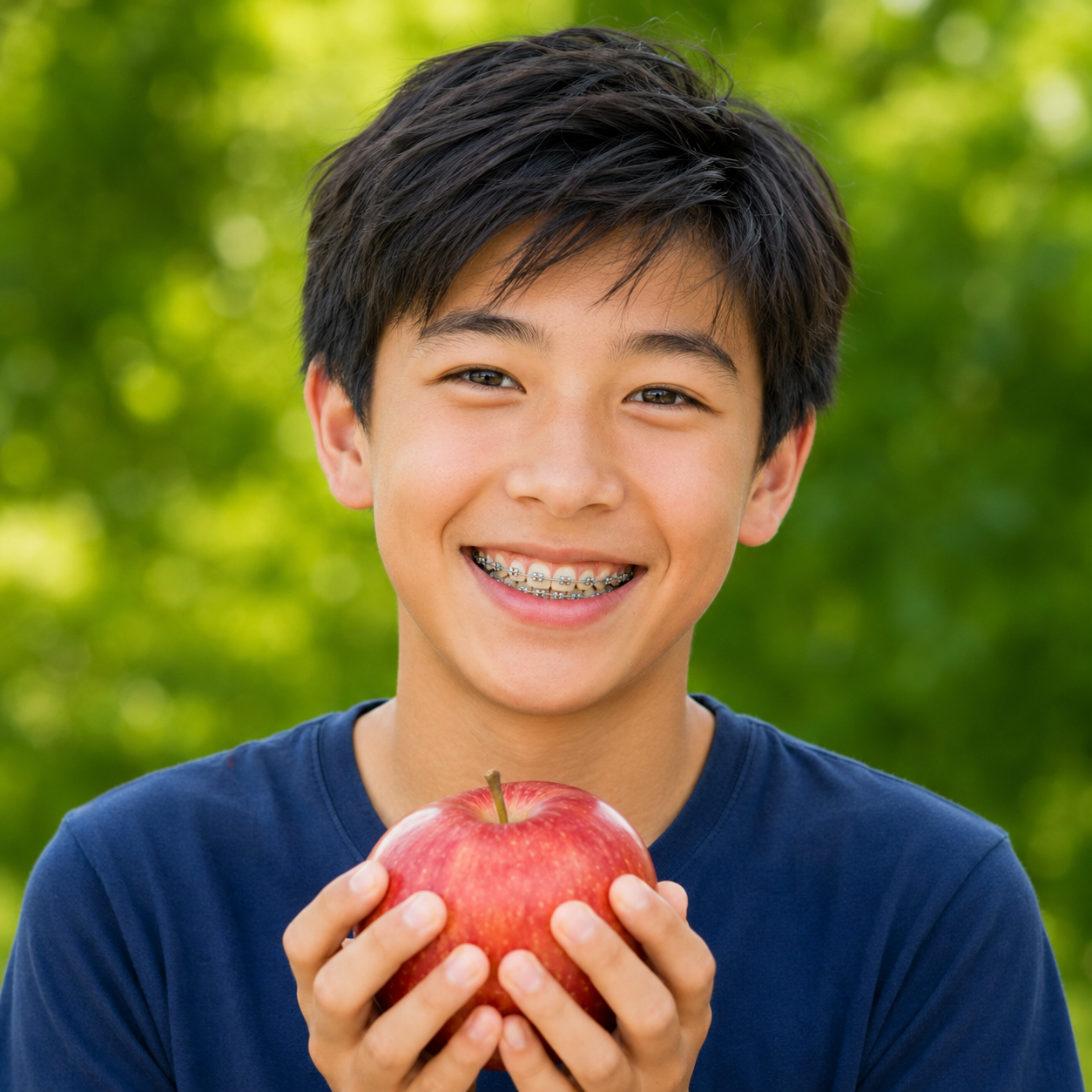
Before your next barbecue, picnic, or beach trip, discover which foods could cause broken brackets and delayed treatment.
KEY TAKEAWAYS
- Soft does not always mean safe. Many soft foods (soft popcorn, ice cream with hard mix-ins, soft cookies with whole nuts) carry hidden hard elements.
- Sugar-free doesn't help braces. Sugar-free gum is just as damaging to braces as the sugary kind because the issue is mechanical chewing, not the sweetener.
- Boba tea pearls are uniquely problematic. The tapioca pearls combine chewy and slippery in a way that pulls hard on brackets and lodges in places that are hard to clean.
- The kids' table is the highest-risk table. Kid summer foods (popcorn, gummies, hard candies, fruit snacks) are often the worst possible choices for braces patients of any age.
- Call us at 408-738-1314 if something happens. Most braces emergencies are minor and quickly resolved. Our Sunnyvale team is here to help.
Introduction
It's a Saturday morning at the Sunnyvale Farmers Market on Murphy Avenue, the kids are eating their way through the samples, and you're trying to remember which fruits your son in braces can actually have. He's already had three samples of crunchy granola, a small handful of dried mango, and a sliver of caramel popcorn from one of the vendors. You're starting to do the orthodontic math in your head, and the numbers aren't adding up.
Most blogs about summer foods and braces give you a list to avoid. The trouble is that lists assume patients are making thoughtful decisions about every food. In real life, patients across Sunnyvale, Mountain View, Santa Clara, and the broader Bay Area make the same five mistakes summer after summer, and these mistakes cause most of the emergencies we see. At Shimizu Orthodontics, Dr. Ken Shimizu and Dr. Kevin Shimizu have helped Bay Area families navigate these decisions for years. This blog names the five biggest summer food mistakes, explains the truth behind each, and gives you the corrected habit to use instead.
Meet Dr. Ken Shimizu and Dr. Kevin Shimizu
Dr. Ken Shimizu and Dr. Kevin Shimizu lead Shimizu Orthodontics with a combined wealth of clinical expertise and a shared dedication to patient-centered care. As a Diamond + Top 1% Invisalign Provider, our practice brings advanced clear aligner expertise alongside traditional braces, with a patient-first philosophy that has built lasting trust across the Bay Area.
Our team has earned more than 145 five-star Google reviews from Sunnyvale families who trust us with their smiles. Whether you're starting traditional braces or Invisalign clear trays, our team is here to help you achieve a happy smile and so much more.
Why These Mistakes Matter So Much
Lists of foods to avoid are useful but incomplete. New summer products, regional snacks, and unfamiliar restaurant menus all fall outside any list. The deeper insight: most summer braces emergencies trace back to assumptions, not unfamiliar foods. Patients break a bracket because they assumed a soft food was safe, a sugar-free product was braces-friendly, or a food they've eaten before would always be fine. Recognizing the mistakes is what prevents them.
Mistake #1: "Soft Means Safe"
This is the most common assumption we hear from patients, and it accounts for more bracket emergencies than any other mistake. The problem is that many foods labeled "soft" actually contain hidden hard elements that wreak havoc on braces.
"Soft Means Safe"
The most common assumption we hear
The Truth:
Soft foods can absolutely break brackets when they contain hidden hard elements. Popcorn looks fluffy but the unpopped kernels at the bottom are essentially small rocks. Soft cookies often contain whole nuts. Soft ice cream becomes dangerous the moment you add hard candy mix-ins, toffee bits, or frozen fruit chunks. The fluffy outer texture doesn't protect the bracket from the hard hidden piece.
What to Do Instead:
Look past the surface texture and inspect the whole food. Ask yourself: are there any hard fragments, mix-ins, or hidden pieces? If yes, modify or skip. Plain ice cream, soft cookies without nuts, and pure soft snacks (like cheese cubes) are genuinely safe.
Mistake #2: "Sugar-Free Means Braces-Safe"
Patients often assume sugar-free versions of problem foods are exempt from braces rules. The logic seems intuitive: if sugar causes decay, sugar-free protects teeth, so it must protect braces too. The clinical reality is different.
"Sugar-Free Means Braces-Safe"
Sweetener type is not the issue
The Truth:
Braces aren't damaged by sugar. They're damaged by mechanical forces (chewing, pulling, sticking). Sugar-free gum still requires the same continuous chewing motion that bends wires and pulls on brackets. Sugar-free hard candies are still just as hard. Sugar-free gummy candies are still just as sticky. The sweetener doesn't change the physical properties that cause the damage.
What to Do Instead:
Apply the same rules to sugar-free products as you do to the sugary versions. If gum is off-limits, sugar-free gum is off-limits. If hard candy is dangerous, sugar-free hard candy is dangerous. Sugar-free mints (which dissolve rather than chew) are a useful exception.
Mistake #3: "I've Eaten This Before with No Problem"
If you've eaten something multiple times during treatment without incident, it seems reasonable to assume it's safe. The clinical reality involves cumulative stress that patients don't see.
"I've Eaten This Before with No Problem"
Past success doesn't predict future bonds
The Truth:
Bracket bonds aren't permanent. Each problematic meal applies stress to the adhesive holding the bracket to the tooth, even when no visible damage occurs. Over time, the bond fatigues. A food you've eaten ten times without issue can be the one that finally pushes the bond past its limit. This is why patients are often surprised when a familiar food causes a sudden problem.
What to Do Instead:
Treat every meal as the first time, especially with foods that fall into the risky categories (hard, sticky, chewy). The fact that you got away with it once or ten times isn't evidence that the food is safe. Build the habit of modifying or skipping risky foods consistently.
Mistake #4: "The Kids Can Eat It, So I Can Too"
This mistake catches adult patients off guard. The assumption is that anything kids eat at family gatherings must be reasonably safe. The reality is the kids' summer table contains some of the worst possible foods for braces patients.
"The Kids Can Eat It, So I Can Too"
Kid summer foods are surprisingly risky
The Truth:
Kid summer staples are heavily skewed toward braces emergencies: gummy fruit snacks, popcorn, hard candies, lollipops, taffy, chewy granola bars, and crunchy chips dominate the kids' table at almost every party. Children without braces handle these fine because they have stronger natural teeth and no orthodontic appliances. Adults in braces have appliances that turn the same foods into hazards.
What to Do Instead:
Bring your own safe snacks to family gatherings. Or scout the table first for the safer options (cheese, soft fruits, veggies cut into bite-sized pieces, soft dips).
Mistake #5: "It's Hot Out, So Anything Cold Is Fine"
Bay Area summers can hit the 90s in the South Bay, and the urge to reach for anything cold is real. Patients often assume that the cooling power of frozen treats compensates for any braces concerns. It doesn't.
"It's Hot Out, So Anything Cold Is Fine"
Temperature is not the variable that matters
The Truth:
Cold foods cause the same damage to braces as room-temperature foods of the same texture. Ice cubes (often the single most preventable cause of bracket damage we see) are dangerous because of hardness, not coldness. Frozen treats with hard candy mix-ins, brittle waffle cones, or crystalline ice chunks (slushies that haven't fully melted) all cause damage regardless of temperature. The cooling sensation doesn't change the mechanics.
What to Do Instead:
Choose cold foods on the same texture criteria you'd use at any temperature. Plain ice cream, sorbet, popsicles without chunks, and chilled fruit smoothies are all safe and cool. Skip the ice cubes, hard mix-ins, and crystalline frozen treats.
Smart Decision Habits That Prevent the Mistakes
Across all five mistakes, the same handful of habits prevent the underlying patterns. Build these into your summer routine, and food decisions become quick and automatic.
- Inspect the whole food, not just the surface. Soft on the outside, hard on the inside is the most common trap. Look inside, look at the mix-ins, look at every component.
- Apply the same rules to sugar-free versions. Sweetener type is not the variable that matters. Mechanical properties are.
- Treat every meal like it's the first time. Familiar foods don't get safer with repetition. They just get more familiar.
- Avoid the kids' table at family gatherings. The grown-up snack options are almost always safer for braces patients.
- Use texture, not temperature, as the deciding factor. Hot or cold doesn't change the mechanics. Hardness, stickiness, and chewiness do.
Why Bay Area Families Trust Shimizu Orthodontics
For Bay Area families seeking braces and Invisalign, Shimizu Orthodontics has built a reputation for honest care and exceptional results. Here is what sets our practice apart.
- Diamond + Top 1% Invisalign Provider: recognized clear aligner expertise, placing our practice in the top 1% of providers nationally
- Two specialty-trained orthodontists: Dr. Ken Shimizu and Dr. Kevin Shimizu bring decades of combined clinical expertise and a shared commitment to patient-first care
- Convenient Sunnyvale location: centrally located to serve families across Sunnyvale, Mountain View, Santa Clara, Cupertino, Los Altos, and the broader South Bay
- Complete treatment options: traditional braces, Invisalign clear aligners, and clear trays, with personalized treatment plans for every age and lifestyle
- A happy smile and so much more: we believe orthodontic care is about more than straight teeth. Our team treats every patient like a neighbor
Conclusion
Summer in the Bay Area doesn't have to mean broken brackets and treatment delays. Once you recognize the five common mistakes, the underlying patterns become easy to catch before they cause problems. Most Bay Area summer foods stay on the menu when you make decisions based on what's in your bite, not what feels intuitive. Our team at Shimizu Orthodontics is here whenever questions come up.
Frequently Asked Questions
Can my child have boba tea this summer?
Yes, but skip the pearls. The milk tea, fruit tea, and flavored bases are all braces-friendly. The tapioca pearls (boba) are the problematic part because they're chewy and slippery in a combination that pulls on brackets. Almost every Bay Area boba shop will happily make your drink pearl-free. Many will also offer alternatives like grass jelly or popping boba, but skip those too during treatment.
Are sushi rolls safe for braces?
Most sushi is completely safe. Soft fish, sticky rice, and soft vegetables make traditional sushi rolls one of the more braces-friendly Bay Area restaurant options. Be careful with crunchy tempura toppings, tobiko (fish roe that can get stuck), and any rolls with hard fried elements. Cut larger rolls into smaller bites with chopsticks or a fork.
My Invisalign aligners feel tight after I eat a hot lunch. Is that normal?
Aligners can feel slightly different after eating warm foods because the trays themselves expand and contract subtly with temperature. The sensation usually settles within minutes of cleaning and reseating the aligners. If the tightness persists or feels painful, call us. Always rinse aligners with cool (not hot) water to avoid warping.
How do I know if I've broken a bracket without it being obvious?
Signs include a bracket that feels loose or shifts when you push it with your tongue, unusual soreness in one specific area, a wire end that suddenly pokes the cheek (which can mean a nearby bracket has moved), and difficulty cleaning around one specific tooth. When in doubt, send us a photo at the office, and we'll evaluate.
What's the best snack to pack for a Bay Area summer hike?
Soft cheese cubes, sliced apples (cut at home, not bitten whole on the trail), soft baked granola bars without whole nuts, hummus packets, and bananas all travel well and are braces-safe. Skip trail mix with whole nuts, hard pretzels, and dried mango. Bring a refillable water bottle for hydration.
Sources
- Stasinopoulos, D., Papageorgiou, S. N., Kawamura, J., Tanimoto, Y., Papadopoulos, M. A., & Jäger, A. (2018). Failure patterns of different bracket systems and their influence on treatment duration: A retrospective cohort study. Angle Orthodontist , 88(5), 596–603. Read full study
- Almosa, N., & Zafar, H. (2018). Incidence of orthodontic brackets detachment during orthodontic treatment: A systematic review. Pakistan Journal of Medical Sciences , 34(3), 744–750. Read full study
- Aljohani, S.R., & Alsaggaf, D.H. (2020). Adherence to Dietary Advice and Oral Hygiene Practices Among Orthodontic Patients. Patient Preference and Adherence , 14, 1991–2000. Read full study
- American Association of Orthodontists. Braces: Treatment Information for Patients. View AAO resources
- American Dental Association. Braces. View ADA resources
This blog is intended for general educational purposes only and is not a substitute for personalized medical, dental, or orthodontic advice. Please contact Shimizu Orthodontics or your healthcare provider with specific questions about your individual orthodontic care, dietary restrictions, or treatment plan.